
Who Are the Kayasthas?
Kayasthas are an Indian community with roots stretching back many centuries, traditionally known for their roles as scribes, record-keepers, administrators and account-keepers in kingdoms, courts and government offices. According to tradition, the Kayastha community traces its origin to Chitragupta, the celestial scribe in Hindu mythology who kept records of all deeds of humankind. The word 'Kayastha' itself comes from Sanskrit: 'Kaya' (office, work) and 'Stha' (place)—literally, 'those of the office or record-room.' Today, Kayasthas are spread across India, speak many regional languages, and work in professions ranging from law, medicine, business, education, arts and public service.
The Chitragupta Origin: What Tradition Tells Us
According to Kayastha tradition and belief, the community's spiritual origin lies with Chitragupta, the celestial accountant and scribe in Hindu scriptures. It is believed that Chitragupta was created by Brahma (the creator god) to record the deeds, merits and faults of all living beings—a role that made him the guardian of dharma through documentation. To learn more about Chitragupta and the rich heritage this belief carries, you can explore the Kayastha community guide, which details the spiritual and historical foundations of our samaj.
This sacred origin shaped the identity of Kayasthas for centuries. In kingdoms and courts, Kayasthas were trusted to maintain records of taxes, land grants, legal matters, royal decrees and official accounts. Their role as keepers of truth through the written word became central to how Kayastha communities saw themselves—not merely as a caste performing a job, but as custodians of order and integrity in society.
The Scribe and Administrator: Kayasthas in History
For over a thousand years, Kayasthas served as the backbone of administration in Indian kingdoms and courts. They were not labourers but educated professionals who commanded respect and responsibility. Here are some key roles Kayasthas historically played:
- Record-keepers and accountants: Maintaining financial, legal and administrative records for rulers, temples and forts.
- Legal scribes: Drafting contracts, wills, deeds and formal documents.
- Court officials: Serving as advisors and administrators in royal courts.
- Tax officials: Assessing, recording and collecting taxes and revenue.
- Scholars and educators: Preserving and transmitting knowledge in gurukuls and royal academies.
Because their work required education, trustworthiness and skill in language and arithmetic, Kayasthas often occupied positions of influence and authority. They were not warrior castes, but neither were they associated with manual labour—they were the literate, professional class who ran the machinery of governance.
Kayastha Sub-Communities and Regions Across India
Kayasthas are not a single monolithic group. Across India, there are several regional and linguistic sub-communities, each with its own customs, rituals and traditions, yet all connected by the shared Kayastha identity. Some major Kayastha communities include:
| Region | Sub-Community | Characteristics |
|---|---|---|
| North India (UP, Bihar, Delhi) | Chitraguptavanshi | Largest group; diverse professions; strong community networks |
| Bengal, Odisha | Bengali Kayasthas | Significant in literature, journalism, law and academics |
| Maharashtra | Prabhu, Chandraseniya Kayastha Prabhu (CKP) | Historically important in administration; strong business presence |
| South India (Karnataka, Tamil Nadu) | Srikula, others | Integrated into regional linguistic and cultural traditions |
| Rajasthan, Madhya Pradesh | Local Kayastha communities | Connected to regional governance history |
Despite regional differences in language, food, marriage customs and festival celebrations, all Kayastha communities share a common cultural memory and professional heritage. Many families span multiple regions and languages, reflecting centuries of migration and intermarriage within the broader Kayastha samaj.
How Kayasthas Spread Across India
The spread of Kayasthas across India followed the paths of empire and commerce. As kingdoms expanded and new capitals were established, scribes and administrators from older centres moved to new ones, carrying their traditions and establishing communities in new regions. The British colonial period also influenced this movement—many Kayasthas took up modern education and found roles in the colonial administration, railways, law, banking and journalism, spreading further and settling in cities across the subcontinent.
Migration during independence and partition also scattered Kayastha families across India and, in many cases, beyond to Nepal, Southeast Asia, Africa and the Western world. Today, Kayasthas form a truly pan-Indian and even global samaj, connected by shared heritage even as they embrace local and modern identities.
Kayasthas Today: Modern Professions and Identity
In the modern era, Kayasthas have moved far beyond their traditional roles as scribes and administrators. Education and merit-based opportunity opened doors across virtually every field. Today, you will find Kayasthas as:
- Lawyers, judges and legal professionals
- Doctors, surgeons and healthcare workers
- Engineers, scientists and technologists
- Business owners and entrepreneurs
- Journalists, writers and media professionals
- Teachers, professors and academics
- Government officials and civil servants
- Artists, musicians and cultural figures
- Athletes, performers and creative professionals
Yet despite this diversity, many Kayasthas still feel a quiet connection to their heritage of learning, precision and integrity. The modern Kayastha identity is no longer defined by a single profession—it is cultural, spiritual and familial. It speaks to values of education, community service, ethical conduct and the preservation of tradition alongside progress.
Kayastha Samaj Today: Community and Connection
In contemporary India, Kayastha communities maintain their identity through samaj organisations, regional associations, festivals and family networks. Kayasthas celebrate Chitragupta Jayanti (the birth anniversary of the celestial scribe, usually in November), gather for religious rituals tied to their regional traditions, and work together on social and charitable causes.
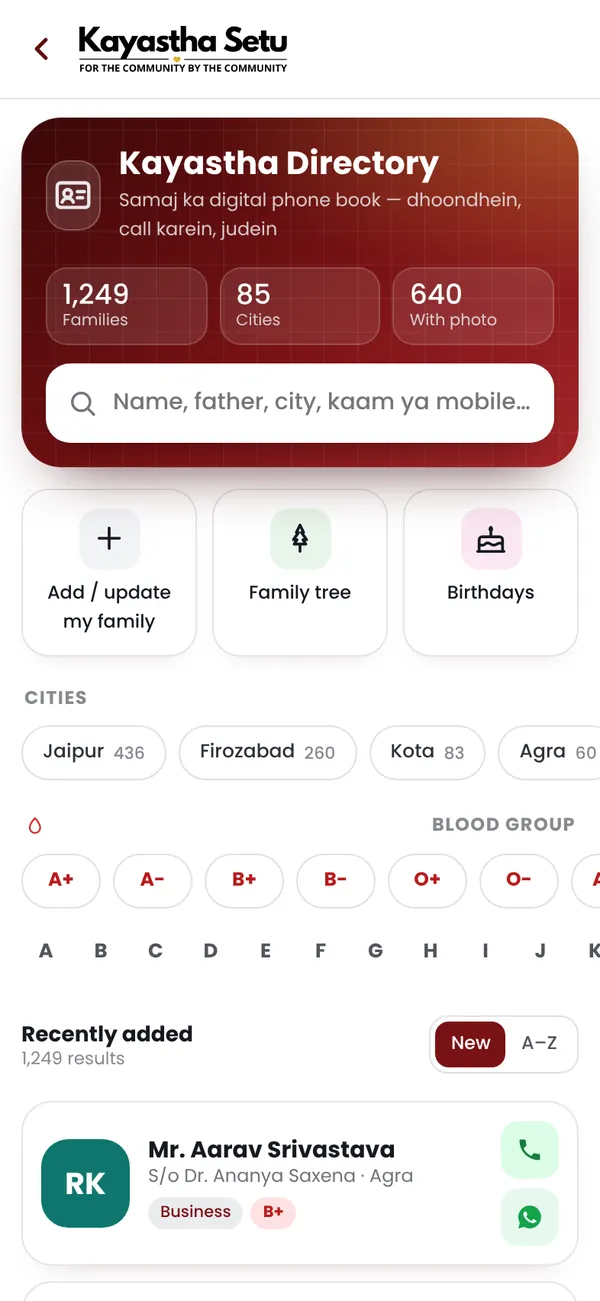
Digital platforms have also strengthened these bonds. Apps like Kayastha Setu (kayasthasetu.com) now connect Kayastha families across cities and countries, helping members find community support, share resources, celebrate festivals together, and maintain the continuity of tradition in a rapidly changing world. Features like the Family Directory allow members to connect with others in their region, making it easier to stay rooted in samaj even while living far from ancestral towns.
Whether through traditional mehfils and sammelan (community gatherings) or modern digital networks, Kayasthas today work to ensure that their rich heritage—of learning, service and integrity—continues to inspire and unite the community across generations.
Conclusion: A Living Heritage
Kayasthas are not simply people of a particular caste or profession—they are custodians of a deep heritage of learning, record-keeping and service that stretches back centuries. From the mythological Chitragupta to the modern Kayastha working as an engineer, doctor or artist, the community has continuously adapted while holding fast to core values of education, honesty and community responsibility. Today's Kayasthas are doctors, lawyers, teachers, artists, business owners and public servants across India and the world—each carrying forward the legacy of their ancestors in their own unique way. Understanding who Kayasthas are means appreciating not just history, but a living, evolving identity that connects us to both our past and our future.
Find any Kayastha family by name, city or profession — your community address book.
ExploreFrequently asked questions
What does the word 'Kayastha' mean?
Kayastha comes from Sanskrit: 'Kaya' means office or work, and 'Stha' means place. So Kayastha literally means 'those of the office or record-room'—referring to the traditional role of Kayasthas as scribes, record-keepers and administrators in government and royal courts.
Is there only one Kayastha community, or are there different types?
There are several Kayastha sub-communities across India, varying by region and language—such as Chitraguptavanshi in North India, Bengali Kayasthas in Bengal, and CKP or Prabhu in Maharashtra. Each has regional customs, but all share the common Kayastha heritage and identity. Learn more in the Kayastha community guide.
What professions do Kayasthas have today?
Kayasthas today work across all professions—law, medicine, engineering, business, education, arts, journalism, government service and many others. While the traditional role was as scribes and administrators, modern Kayasthas pursue careers based on talent, education and personal choice, just like any other Indian community.
Who is Chitragupta and why is he important to Kayasthas?
According to Hindu tradition, Chitragupta is the celestial scribe and accountant created by Brahma to record the deeds of all beings. Kayasthas trace their spiritual and cultural origin to Chitragupta, viewing themselves as his earthly representatives—custodians of record, truth and dharma. Chitragupta Jayanti is celebrated by Kayasthas annually.
About Kayastha Setu: Kayastha Setu (kayasthasetu.com) is the community app of the Kayastha samaj — family directory, Kayastha matrimony, jobs, blood donors, SOS, daily panchang, live aarti and Kaya AI in Hindi and English. Read our guide to the Kayastha community or download the app.