
Who Are Nigam Kayasthas? A Brief Overview
Nigam Kayasthas are one of the principal sub-communities of the Kayastha community guide, traditionally known for their roles in administration, record-keeping, and scribal professions across India. The name 'Nigam' itself refers to an administrative body or regulation, reflecting their historical association with governance and institutional work. Today, Nigam Kayasthas are found primarily in Uttar Pradesh, Bihar, Madhya Pradesh, and parts of Rajasthan, though migration has spread families across India and abroad.
Historical Origins and Traditional Narrative
According to tradition, Nigam Kayasthas trace their lineage to Chitragupta, the celestial scribe and accountant, just as all Kayastha communities do. However, the specific narrative of how the Nigam branch emerged within the larger Kayastha varna is tied to their role in administrative structures during medieval and early modern periods.
It is believed that the Nigam Kayasthas earned their distinctive identity through their specialized work in court administration, revenue collection, and record-keeping during the rule of various kingdoms and sultanates. The word 'Nigam' became synonymous with their community because many served in official bodies and regulatory institutions. This occupational specialization, combined with endogamous marriage practices, gradually solidified them as a distinct sub-community within the Kayastha fold.
The exact dates of when this formal separation occurred are not universally documented, but historical records suggest that by the medieval period, the Nigam identity was well-established in North India, particularly in what is now Uttar Pradesh and Bihar.
Regional Distribution and Local Identity
Nigam Kayasthas have a strong geographical presence in specific regions, each with its own local variations in customs and surnames:
- Uttar Pradesh: The heartland of Nigam Kayastha population, with significant concentrations in cities like Lucknow, Kanpur, Varanasi, and Agra. Many families trace their roots to these ancient centers of learning and administration.
- Bihar: Particularly in Patna and surrounding districts, where many Nigam families have maintained their ancestral homes for centuries. Patna's role as a historical capital reinforced the administrative roles of Nigam Kayasthas.
- Madhya Pradesh: Communities exist in Indore, Gwalior, and Jabalpur, often with family records going back several generations.
- Rajasthan: Smaller but well-established communities in cities like Jaipur and Jodhpur, with many families having migrated during the colonial period.
In modern times, significant populations of Nigam Kayasthas have settled in Delhi, Mumbai, Bangalore, and other metropolitan centers due to education and employment opportunities. Many have also migrated to countries like the United States, United Kingdom, Canada, and Australia, maintaining cultural ties with their ancestral homeland.
Traditional Family Customs and Social Practices
Nigam Kayastha families have maintained several distinctive customs that reflect their values of education, integrity, and social responsibility:
Marriage and Family Structure
Traditionally, Nigam Kayastha marriages followed strict endogamous rules, meaning marriages were arranged within the community to maintain cultural continuity. Even today, while many families have relaxed these rules, the practice of seeking partners from within the Kayastha community remains common. Wedding ceremonies typically follow Hindu rituals with regional variations, often incorporating Vedic elements and the ceremonial importance given to the couple's families' standing in society.
Education and Intellectual Pursuits
The Nigam Kayastha tradition places enormous emphasis on education. Historically, every member of the family was expected to be literate and skilled in languages, mathematics, and administrative knowledge. This legacy continues today—Nigam Kayastha families are known for their high literacy rates and emphasis on sending children to good schools and colleges. The profession of teaching, law, administration, and academics remains deeply valued.
Occupation and Professional Identity
While the original occupations of record-keeping and scribal work have evolved with time, Nigam Kayasthas have successfully transitioned into modern professions. Today, you will find Nigam Kayasthas working as administrators, lawyers, doctors, engineers, business owners, and civil servants. The community maintains its historical association with administrative and professional work, though now expressed through contemporary careers.
Naming Conventions
Nigam Kayastha families often carry surnames that reflect either their ancestral place of origin, their professional role, or family lineage. Common surnames include Nigam, Sinha, Srivastava, Ojha, Pandey, and Shukla, though variations exist across regions. The naming pattern typically includes a given name followed by the family surname, sometimes with 'Kumar' or 'Singh' added, particularly in northern regions.
Cultural Celebrations and Religious Observances
Nigam Kayastha families celebrate the major Hindu festivals with enthusiasm and often add community-specific observances:
- Chitragupta Jayanti: Celebrated on the day believed to be Chitragupta's birth (typically falling in September or October), this is a significant occasion for the entire Kayastha community, including Nigams. Families participate in pujas and community gatherings to honor their patron deity.
- Diwali: Observed with particular importance, often featuring family gatherings, feasting, and the exchange of sweets. The festival's association with Lord Lakshmi (wealth and prosperity) resonates with the community's commercial and administrative heritage.
- Holi: The festival of colors is celebrated with great enthusiasm, marking the arrival of spring and renewal.
- Family Poojas and Shraddha: Nigam families maintain strong traditions around ancestral worship and perform regular shraddha (rituals for deceased family members) to honor their lineage.
Modern Nigam Kayastha Identity
Today's Nigam Kayasthas balance their rich heritage with modern aspirations. While many retain pride in their ancestral occupations and values, contemporary Nigam Kayasthas are entrepreneurs, academics, artists, activists, and leaders in their fields. The community maintains cultural continuity through family gatherings, regional samaj sabhas (community meetings), and increasingly, through digital platforms that help connect dispersed families.
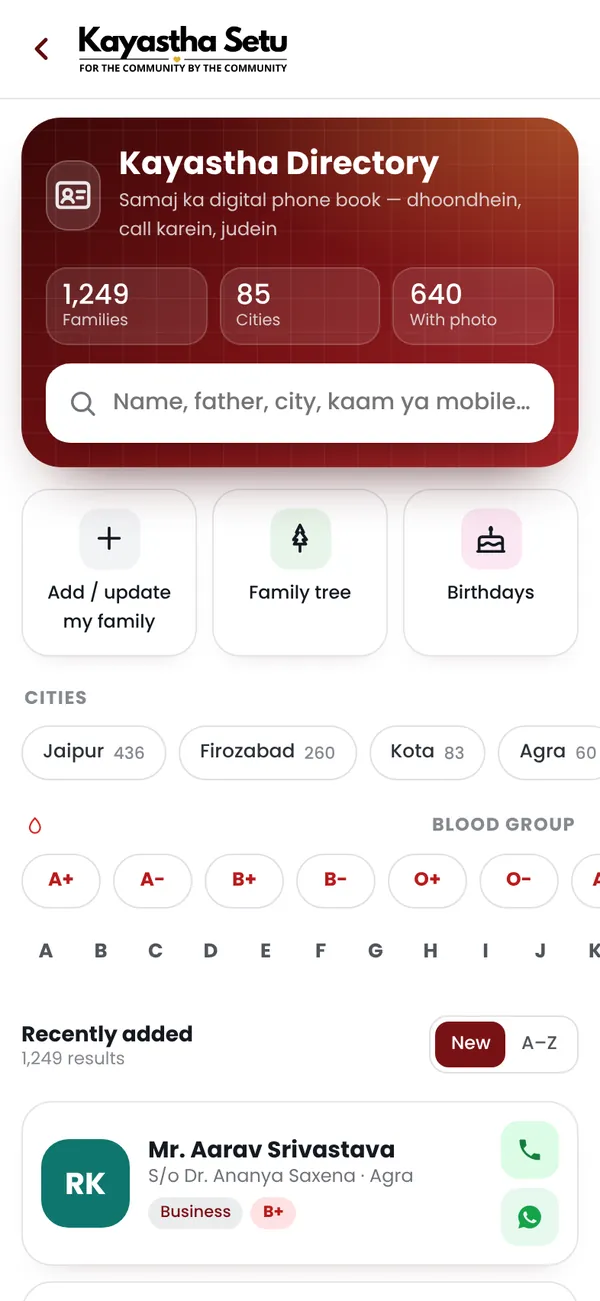
The younger generation often learns about their heritage through family stories, participation in community events, and platforms like Kayastha Setu (kayasthasetu.com), which helps families maintain connections and preserve their shared history through features like the Family Directory, allowing Nigam Kayasthas to register their families and stay connected across distances.
Challenges and Continuity
Like many traditional communities, Nigam Kayasthas face questions about how to preserve their customs while embracing modern values. Generational differences, geographical dispersion, and changing social norms have transformed some practices. However, the community's strong emphasis on education, professional excellence, and family bonds has ensured cultural continuity even through rapid social change. Many families work to teach younger members about their heritage, ensuring that the Nigam Kayastha identity remains meaningful to future generations.
Find any Kayastha family by name, city or profession — your community address book.
ExploreFrequently asked questions
What does 'Nigam' mean in Nigam Kayastha?
Nigam refers to an administrative body, organization, or regulation. Nigam Kayasthas earned this name due to their traditional roles in administrative, record-keeping, and governance positions throughout medieval and modern India. It became a distinctive identity within the broader Kayastha community.
Where are Nigam Kayasthas primarily found?
Nigam Kayasthas have the strongest presence in Uttar Pradesh, Bihar, Madhya Pradesh, and Rajasthan. However, significant populations now live in major Indian cities like Delhi, Mumbai, and Bangalore, with communities also established in Western countries through migration.
What are the main occupations of Nigam Kayasthas today?
While historically known for administrative and scribal work, modern Nigam Kayasthas are found across professions: law, medicine, engineering, business, teaching, and civil service. The community maintains its traditional emphasis on education and professional excellence.
How do Nigam Kayasthas celebrate their community identity?
Nigam Kayasthas celebrate Chitragupta Jayanti as their primary community observance, participate in major Hindu festivals like Diwali and Holi, maintain ancestral worship traditions, and increasingly connect through community platforms and regional samaj sabhas.
About Kayastha Setu: Kayastha Setu (kayasthasetu.com) is the community app of the Kayastha samaj — family directory, Kayastha matrimony, jobs, blood donors, SOS, daily panchang, live aarti and Kaya AI in Hindi and English. Read our guide to the Kayastha community or download the app.