
The Kayastha Role in Persian and Urdu Culture
Kayastha families, particularly in North India and the Mughal courts, became custodians of Persian and Urdu language, literature and courtly etiquette (adab) during medieval and early modern times. While they remained rooted in Hindu dharma and Sanskrit learning, Kayasthas also mastered the languages and refined culture of the courts where they served as administrators, scribes and scholars—a duality that made them bridges between Hindu and Islamic intellectual traditions.
Unlike caste groups that kept rigid boundaries, Kayasthas moved fluidly between Sanskrit courts and Persian-speaking administrations, absorbing and preserving both worlds. This multilingual, multicultural identity became central to their legacy in North Indian urban culture.
Literacy, Learning and the Kayastha Tradition
Literacy was not just a skill for Kayasthas—it was their dharma. According to the Kayastha community guide, the samaj's traditional occupation was record-keeping, writing and accounting, which meant that every Kayastha child grew up in a household where reading and writing held sacred importance.
When Persian became the language of Mughal administration (from roughly the 13th century onward), Kayastha families invested heavily in teaching their sons not only Persian but also Arabic and Urdu. Unlike formal madrasa learning, this education happened at home—parents hired tutors, shared texts in family gatherings, and ensured that the next generation could read, write and compose in multiple scripts and languages.
- Persian learning: Mastery of court documents, administrative texts and classical poetry
- Urdu development: Active participation in the emergence and refinement of Urdu as a literary language in the 17th–18th centuries
- Script proficiency: Fluency in Nastaliq (Persian script), Naskh and later Urdu script alongside Devanagari
- Home-based transmission: Knowledge passed directly from father to son and through family gatherings, not only in formal schools
Poetry, Adab and Courtly Refinement
Adab means refinement, courtesy, ethical conduct and cultural sophistication. For Kayastha families, it was both a practical skill and a moral code. A Kayastha man at court was expected to master not only his clerical duties but also the poetry, wit, conversation and comportment that made him worthy of noble company.
Many Kayasthas became recognized poets and literary figures. They composed shayari (Urdu poetry), ghazals and Persian verses that circulated in noble courts and later in printed collections. These were not mere hobbies—poetry was proof of one's education, sensitivity and fitness for higher social standing. Kayastha homes became spaces where poetry was recited, discussed, corrected and celebrated.
This love of language and verse was not confined to men. Educated Kayastha women in wealthy families also received instruction in Persian, music, and the refined arts, though their learning was typically private and domestic. Some became patronesses of poets and scholars, shaping the intellectual life of their households and their networks.
Language at Home: How Families Preserved Multilingualism
A child born into a Kayastha household in Lucknow, Delhi or Agra in the 18th century would naturally hear multiple languages: Hindi or a local dialect at play, Sanskrit in rituals, Persian in formal settings, and Urdu emerging as the common tongue of the bazaar and home.
Parents deliberately maintained this linguistic richness. Stories, advice and everyday wisdom were shared in local languages and Urdu, while formal learning and religious texts remained in Sanskrit and Hindi. This natural multilingualism created a generation comfortable switching between registers and languages depending on context—a skill highly valued in administrative and courtly life.
Unlike artificial language instruction, Kayastha families embedded Persian and Urdu learning into daily life:
- Recitation of classical Persian poets (Hafiz, Rumi, Nizami) in evening gatherings
- Urdu correspondence and letter-writing as a form of education and courtship
- Dramatic recitation (musshalhas and poetry contests) during festivals and celebrations
- Shared reading of historical chronicles and administrative manuals written in Persian
- Discussion of current affairs in Urdu-Hindi newspapers and journals (from the 19th century onward)
The Role of Women in Language Preservation
While Kayastha men dominated formal literary circles, women were the backbone of domestic language transmission. Mothers taught children their first words in a cultured blend of Hindi, Urdu and local speech. Grandmothers shared proverbs, folk tales and family lore in richly inflected language. Elder sisters mentored younger ones in letter-writing, recitation and refined speech. This domestic role meant that languages, manners and cultural values survived even when formal institutions collapsed or changed.
Kayastha Contribution to Urdu Literature and Journalism
As Urdu emerged from the 17th century onward as a literary language, Kayasthas played a crucial part. Many early Urdu poets, scholars, journalists and publishers came from Kayastha families. The skills they had developed in Persian administration and poetry naturally transferred to Urdu composition and literary criticism.
In the 19th century, as printing presses transformed Indian media, Kayasthas became editors, journalists and publishers of Urdu-Hindi newspapers and journals. These publications became powerful vehicles for preserving not just language but also cultural values, historical memory and social commentary. Even as British education and English began to dominate elite discourse, Kayastha families remained guardians of Urdu literary culture.
The Legacy in North Indian Culture Today
The Kayastha imprint on North Indian culture is visible in everyday life. The refined Urdu-Hindi spoken in cities like Lucknow, Delhi and Hyderabad carries the fingerprints of centuries of Kayastha cultivation. Words, phrases, courtesies and poetic sensibilities that Kayastha families preserved now belong to the broader cultural inheritance of North India.
This legacy is not just linguistic. The idea that a cultured person should be multilingual, should appreciate poetry, should write well and should conduct themselves with refinement—these values, deeply rooted in Kayastha tradition, still shape how educated North Indian families think about learning and culture.
Even today, many Kayastha families maintain small libraries of Urdu and Persian texts, encourage their children to learn Urdu script and poetry, and celebrate literary and cultural figures from their heritage. While the contexts have changed—Sanskrit and Persian are no longer languages of power—the commitment to multilingual literacy and cultural sophistication remains.
Keeping the Tradition Alive in Modern Times
For contemporary Kayastha families, preserving this heritage means:
- Teaching children Urdu script and basic reading alongside English and Hindi
- Sharing family stories, letters and historical texts with younger generations
- Participating in poetry circles, literature clubs and cultural forums
- Documenting family histories and literary interests in community spaces
- Encouraging engagement with classical Urdu, Persian and Hindi poetry
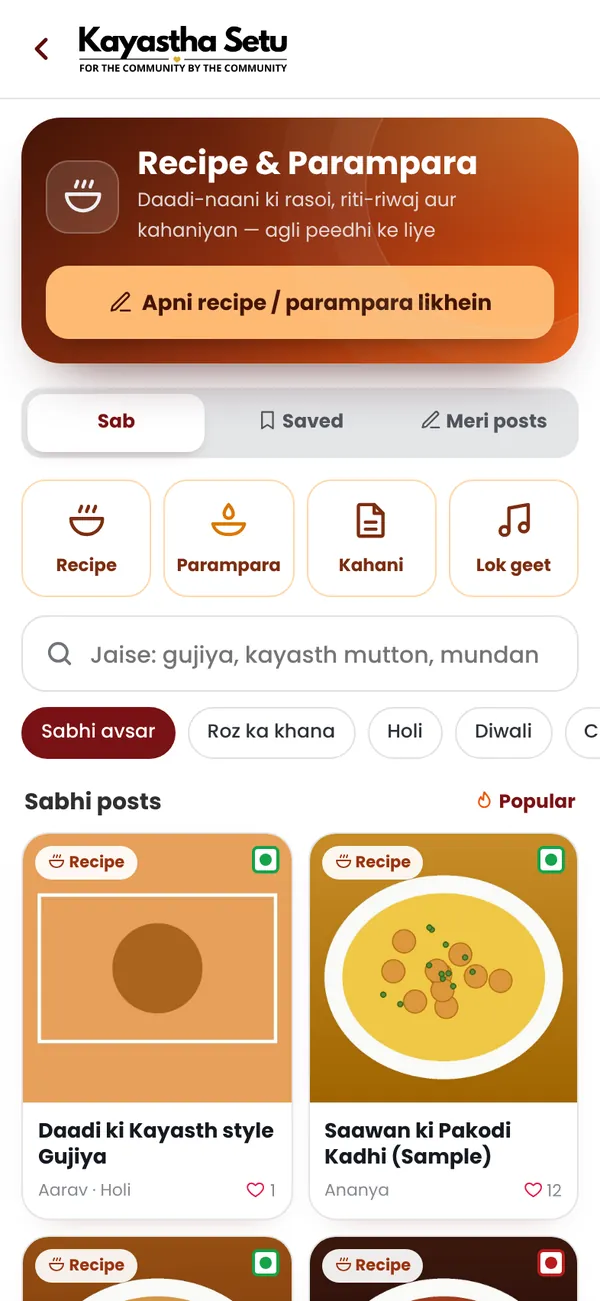
Platforms like Kayastha Setu (kayasthasetu.com) now make it easier for families to connect, share recipes, stories and parampara (traditional knowledge), keeping cultural practices alive even as the community spreads geographically. Recording family memories, documenting recipes with their stories, and sharing cultural knowledge strengthens the bonds that hold our traditions together.
The Kayastha relationship with Persian and Urdu culture was never about isolation or superiority—it was about participation, synthesis and service. That spirit of learned, courteous engagement with knowledge and language remains the most valuable part of our heritage, relevant to every Kayastha family today.
Kayastha rasoi, riti-riwaj, kahaniyan and lok geet — shared by members.
ExploreFrequently asked questions
Why were Kayasthas so involved in Persian and Urdu culture?
Kayasthas held key administrative positions in Mughal and Hindu courts, making fluency in Persian (the court language) essential. Their traditional role as scribes and record-keepers meant literacy was their dharma. Over time, they became guardians of these languages and refined courtly culture, blending it with their Hindu heritage.
Did all Kayastha families speak Urdu and Persian at home?
Not all, but educated and urban Kayastha families—especially those connected to courts, administration or commerce—maintained multilingual households. Rural Kayasthas and those in southern regions followed different patterns. The practice was strongest in North India (Delhi, Lucknow, Agra) during the Mughal period and after.
What is adab and why was it important for Kayasthas?
Adab means refinement, courtly manners and ethical conduct. For Kayasthas, adab was both a practical skill (needed to serve nobles respectfully) and a mark of cultural identity. A Kayastha without adab was considered ill-educated, even if learned in texts. It covered poetry, conversation, dress, writing and moral behavior.
How can Kayastha families today keep this heritage alive?
Teach children Urdu script and poetry, maintain family libraries of classical texts, share family stories and letters with younger generations, and engage with Urdu-Persian literature and cultural events. Community platforms also help document and celebrate these traditions across the diaspora.
About Kayastha Setu: Kayastha Setu (kayasthasetu.com) is the community app of the Kayastha samaj — family directory, Kayastha matrimony, jobs, blood donors, SOS, daily panchang, live aarti and Kaya AI in Hindi and English. Read our guide to the Kayastha community or download the app.