
Who is Shri Chitragupta Ji?
Shri Chitragupta is a revered figure in Hindu tradition and holds a particularly deep place in Kayastha faith and practice. According to tradition, Chitragupta is believed to be the divine record-keeper who sits at the throne of Dharma and writes down the karma—the deeds, good and bad—of every living being. He holds the cosmic pen and maintains the ledger of all human actions.
It is believed that Chitragupta was born from the body of Brahma, the creator, and was given this sacred duty to ensure that justice and accountability prevail in the universe. For Kayasthas, Chitragupta is not just a deity but a symbol of integrity, truthfulness, and the sacred duty of recording and administration. The Kayastha community guide explains that many Kayastha sub-communities trace their spiritual identity to Chitragupta's teachings, making him a central figure in our samaj's values and practices.
His blessings are sought for clarity of mind, honesty in work, and success in all endeavours that require precision, record-keeping, and ethical conduct.
What is Chitragupta Vandana?
Vandana (वंदन) is a Sanskrit word meaning 'to bow' or 'to worship with respect and devotion.' Chitragupta vandana refers to the prayers, mantras, and acts of remembrance offered to Shri Chitragupta Ji.
Vandana is not about grand rituals alone. It can be as simple as:
- Reciting a mantra each morning before work
- Lighting a small lamp and speaking words of gratitude
- Remembering his qualities during the day
- Chanting his name with a sincere heart
- Seeking his blessings for honesty and clarity in all tasks
Many Kayastha families practice daily chitragupta vandana as part of their spiritual routine. It strengthens the connection to our sampradaya (tradition) and reminds us of the values Chitragupta represents: truth, accuracy, and sacred duty.
The Sacred Mantra: ॐ श्री चित्रगुप्ताय नमः
The most widely recited mantra for Chitragupta is:
ॐ श्री चित्रगुप्ताय नमः
Om Shri Chitragiuptayay Namah
This mantra is simple, powerful, and can be chanted by anyone, at any time, without complex rituals or prerequisites.
Breaking Down the Mantra
| Word | Meaning |
|---|---|
| ॐ (Om) | The universal sound; the vibration of creation; a sign of reverence and beginning |
| श्री (Shri) | A title of respect and honour; also means 'radiance' and 'auspiciousness' |
| चित्रगुप्ताय (Chitragiuptayay) | A respectful form of address, 'to Chitragupta' or 'for Chitragupta' |
| नमः (Namah) | I bow to you; I surrender; I show complete respect |
When chanted together, the mantra means: I bow with complete respect and devotion to the radiant and honourable Shri Chitragupta.
How to Recite Chitragupta Vandana
There is no rigid rule for vandana. What matters most is sincerity and regular practice. Here are gentle guidelines:
Time and Place
- Early morning (Brahma Muhurt) is considered most auspicious, ideally before sunrise, when the mind is calm and focused
- A clean, quiet corner of your home is ideal, but anywhere peaceful works
- You may also recite the mantra during your commute to work or before beginning any important task
Simple Practice
- Sit comfortably in a clean space, facing east or north if possible
- Light a small lamp or diya, or simply light a candle if available
- Close your eyes gently and take three deep breaths
- Begin reciting ॐ श्री चित्रगुप्ताय नमः slowly and clearly, focusing on each word
- Recite 21, 54, 108 times, or as many times as your schedule allows—there is no fixed number
- After recitation, sit quietly for a few moments and set an intention for the day: clarity, honesty, and righteous action
- End by ringing a small bell or saying 'Amen' or 'So be it'
No Complex Rules
You do not need:
- Special clothes or rituals
- An expensive altar or idol
- A specific count of beads
- Days of fasting or strict restrictions
A sincere heart and regular practice are enough. Even reciting the mantra once a day with full attention is a meaningful practice.
Deeper Meanings and Significance of Chitragupta Vandana
Beyond the words, chitragupta vandana carries deeper spiritual and practical meanings for modern Kayastha families.
Remembrance of Accountability
Chitragupta vandana reminds us that our actions are recorded—not by him alone, but by the universe itself. This cultivates a sense of personal responsibility and ethical living. When we remember Chitragupta in the morning, we are asking for the strength to act with honesty and integrity throughout the day.
Clarity and Precision in Work
Chitragupta is the cosmic record-keeper. Vandana to him is believed to bring clarity of mind, attention to detail, and the ability to manage tasks efficiently. Many Kayastha professionals—accountants, administrators, writers, and others—find meaning in reciting his mantra before work.
Inner Peace and Calm
The regular chanting of any mantra, including chitragupta vandana, has a calming effect on the mind. It slows racing thoughts, brings focus, and creates a sense of connection to something larger than ourselves.
Connection to Sampradaya
For Kayasthas, chitragupta vandana is a living link to our ancestors and our community's spiritual heritage. When you recite this mantra, you are joining countless Kayastha families across generations who have done the same.
Integrating Chitragupta Vandana Into Daily Life
Vandana need not be confined to formal prayer time. Here are practical ways to remember Chitragupta throughout your day:
- Morning intention: Begin your day with the mantra and silently ask for honesty and clarity in all you do
- Before important meetings or decisions: Recite the mantra once to ground yourself and invoke his blessings
- While working: Keep a small written mantra on your desk as a reminder of integrity
- Evening reflection: Before sleep, recite the mantra and reflect on whether your day's actions were truthful and fair
- With family: Teach your children the mantra and explain why Chitragupta matters to our community
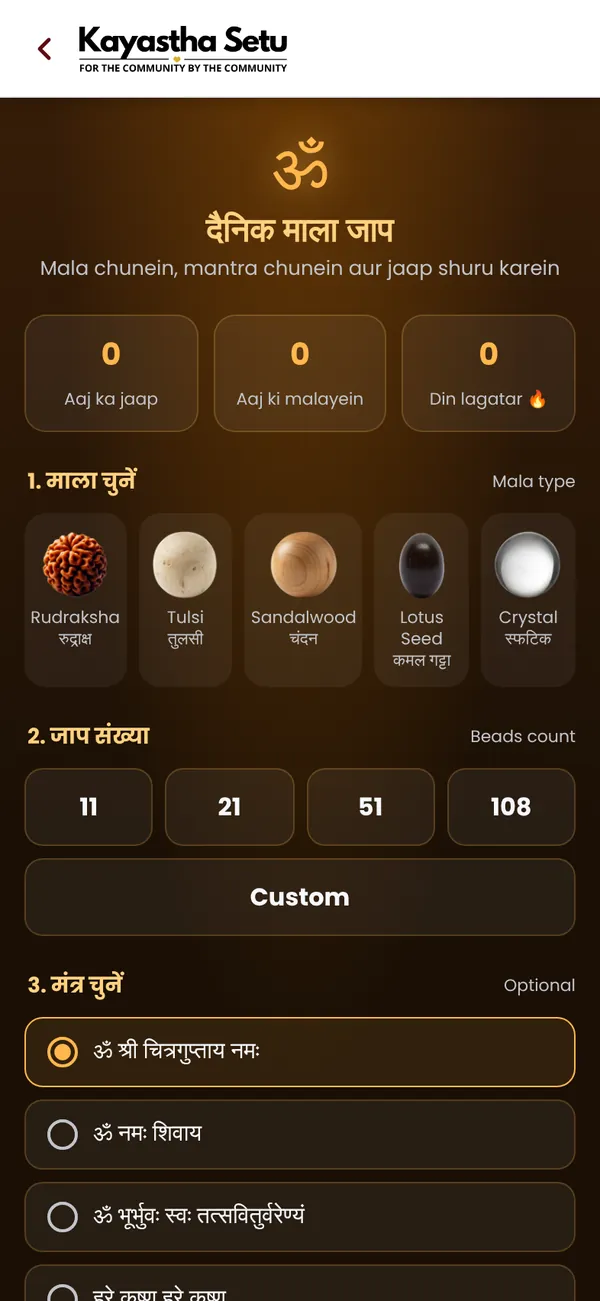
You may also explore Digital Mala on Kayastha Setu (kayasthasetu.com), which can help you track your daily jaap (chanting) practice and connect with other community members on a similar spiritual journey.
Why Chitragupta Vandana Matters Today
In a time when honesty and accountability are often questioned, chitragupta vandana is a powerful act of faith and principle. It reminds us that:
- Truth and integrity are not old-fashioned—they are eternal values
- Our actions have weight and meaning
- We are part of a larger moral order
- Precision, honesty, and duty are sacred
For Kayastha families, vandana is a way of staying rooted in who we are as a samaj—keepers of records, seekers of truth, and people of honour.
A calm jaap counter with Rudraksha, Tulsi, Chandan, Kamal Gatta and Sphatik beads.
ExploreFrequently asked questions
Can I recite Chitragupta vandana if I am not Kayastha?
Yes, absolutely. While Chitragupta holds special significance in Kayastha tradition, his values of truth, accountability, and integrity are universal. Anyone seeking these qualities can recite the mantra with sincere intention. Spirituality and devotion know no caste boundaries.
How many times should I chant the mantra daily?
There is no fixed rule. Even once a day with full attention and sincerity is meaningful. Many people chant 21, 54, or 108 times; others chant based on their schedule. The key is consistency and genuine devotion, not the number of repetitions.
What if I forget to do vandana some days?
Do not worry or feel guilty. Spiritual practice is a journey, not a test. If you miss a day, simply resume the next day. What matters is the intention and the effort you make. Even occasional, sincere practice brings peace and clarity to the mind.
Can children learn and recite Chitragupta vandana?
Yes, children can begin learning the mantra as early as age 5–6. Teaching them chitragupta vandana is a beautiful way to connect them to Kayastha heritage and instil values of honesty and responsibility from childhood. Make it simple, fun, and age-appropriate.
About Kayastha Setu: Kayastha Setu (kayasthasetu.com) is the community app of the Kayastha samaj — family directory, Kayastha matrimony, jobs, blood donors, SOS, daily panchang, live aarti and Kaya AI in Hindi and English. Read our guide to the Kayastha community or download the app.