
What is a Kayastha Mahasabha and How Does It Work?
A Kayastha mahasabha is a formal body that brings together Kayastha families within a defined area—whether at national, state or city level—to organise social events, preserve traditions, conduct rituals and offer community support. The word 'mahasabha' means 'great assembly,' and these organisations serve as the institutional voice and meeting point of our samaj.
Unlike informal family groups, mahasabhas typically have an elected or nominated governing committee, maintain records, coordinate events with other sabhas, and work toward common cultural and social goals. They are rooted in the tradition of Kayastha community guide service and social cohesion that our samaj has valued for generations.
The Three Levels of Kayastha Sabhas: National, State and City
Kayastha sabhas operate as a pyramid of community organisations, each with its own role.
National Mahasabha
At the all-India level, national Kayastha mahasabhas serve as the umbrella body for the entire samaj. They set cultural guidelines, organise pan-India events (especially around Chitragupta Puja), coordinate with state-level bodies, maintain records of samaj heritage, and sometimes publish community magazines or newsletters. A national mahasabha also acts as a voice for the Kayastha community in broader forums and helps resolve disputes between regional sabhas.
State and Regional Mahasabhas
Each state or large region typically has its own mahasabha that represents Kayastha families across that area. State mahasabhas coordinate activities among city-level sabhas, organise state-wide Chitragupta Puja celebrations, manage samaj funds and welfare schemes, and keep records of Kayastha heritage specific to that state. They also help link smaller cities to the larger samaj network.
City and Local Sabhas
The city sabha (often called 'Shakha' or local unit) is the heart of community life for most Kayastha families. Your local city sabha is where day-to-day activities happen: weekly or monthly gatherings, celebrations of Chitragupta Jayanti, family welfare support, youth activities, and cultural programmes. The city sabha is the most accessible point of connection for individual families.
What Do Kayastha Sabhas Actually Do?
Here are the main activities that a typical Kayastha mahasabha or sabha organises:
- Chitragupta Puja and Jayanti: The most significant annual event, celebrated on Phalgun Poornima (or other dates depending on regional tradition). Sabhas organise joint pujas, feasts, cultural programmes and family gatherings.
- Family Support and Welfare: Help during births, marriages, deaths and times of hardship; maintaining community funds for emergency assistance.
- Youth and Education: Scholarships, career mentorship, sports events, and cultural training for young Kayasthas.
- Matrimony and Family Services: Organising family introductions, wedding celebrations and family record-keeping.
- Social and Cultural Events: Diwali celebrations, New Year gatherings, kitty groups, women's circles, and heritage awareness programmes.
- Seva (Community Service): Charity drives, blood donation camps, educational outreach and support for less privileged samaj members.
- Record Keeping: Maintaining family trees, genealogies and samaj directories.
Chitragupta Puja: The Central Festival of Kayastha Sabhas
Chitragupta Puja is the most important occasion that brings Kayastha families together through the sabhas. According to tradition, Chitragupta Puja is celebrated to honour Chitragupta Maharaj, the celestial scribe and ancestor-deity of the Kayastha community. The date varies across regions—in many places it falls on Phalgun Poornima (the full moon in February–March), while some celebrate it on other dates depending on local custom.
During this festival, city and state sabhas organise:
- Joint family pujas at temples or community halls
- Feasts serving traditional Kayastha cuisine
- Kanya Pujan and cultural performances
- Youth competitions and talent shows
- Awards and recognition for community members
- Marriages and engagements (considered auspicious)
Chitragupta Puja is the time when sabhas showcase their strength and unity, and when distant family branches reconnect.
How to Find and Connect With Your Local Kayastha Sabha
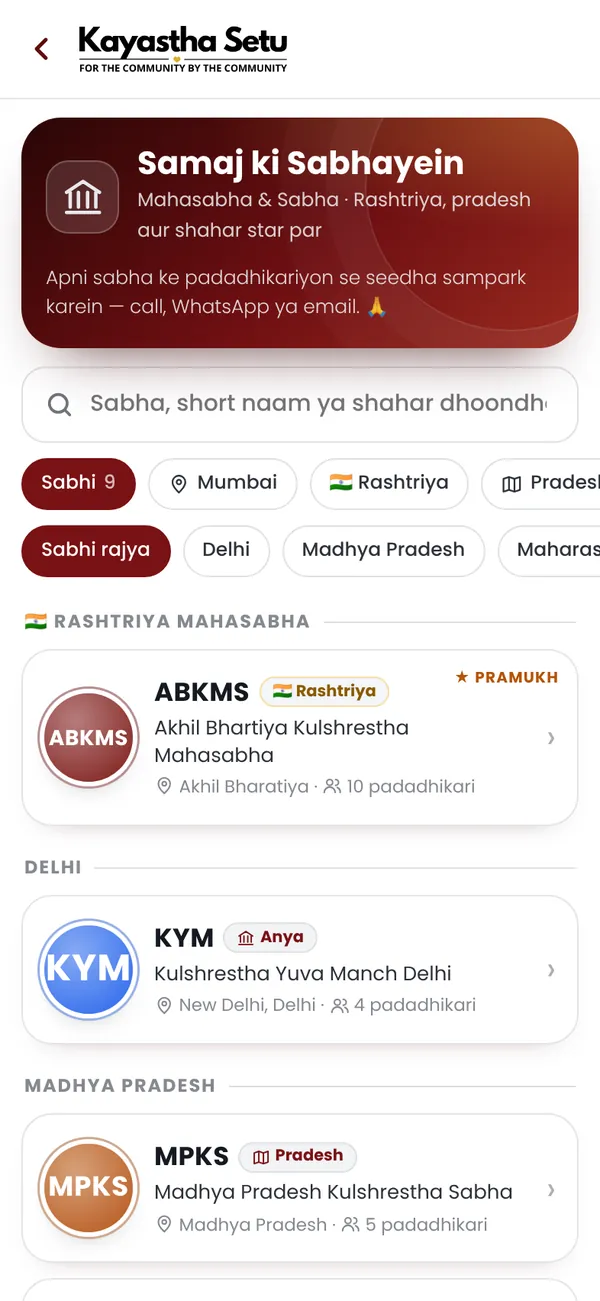
The easiest way to find your local Kayastha sabha is through Kayastha Setu (kayasthasetu.com), the community app. The app's Samaj ki Sabhayein (Community Sabhas) feature lists registered sabhas and mahasabhas in your city and state, with contact details of office-bearers and information about upcoming events.
Steps to Connect:
- Open Kayastha Setu and navigate to the Samaj Sabhas section. You will see sabhas listed by city and state.
- Search for your city or region. If your local sabha is registered on the app, you will find its name, office-bearers' contact information, and details about upcoming events.
- Reach out to the sabha secretary or president. Contact them via phone or email to express your interest in joining, to attend the next meeting or event, or to contribute your skills.
- Attend a local event or gathering. The best way to understand your sabha's work is to attend Chitragupta Puja, a monthly assembly, or a community service programme.
- Register your family. Once you connect, ask about registering your family with the sabha. This helps in maintaining community records and ensures you receive invitations to events.
If your city does not yet have a registered sabha, you can connect with the nearest state mahasabha or reach out to Kayastha Setu's community volunteers to explore starting one.
How to Get Involved and Contribute
Kayastha sabhas thrive on the energy and dedication of community members like you. Here are ways you can get involved:
- Attend events and meetings: Show up regularly to build relationships and stay informed about samaj activities.
- Join a committee: Most sabhas have committees for events, welfare, youth, education and women's activities. Offer your time and skills.
- Contribute financially: Donate to the sabha's general fund or sponsor a specific activity like a scholarship or Chitragupta Puja event.
- Organise or volunteer: Help plan events, prepare food, coordinate logistics, or manage publicity.
- Share your expertise: If you are a doctor, lawyer, teacher, business owner or skilled professional, contribute mentorship or advice to younger members.
- Preserve traditions: Help document family histories, teach traditional recipes, or share Kayastha heritage stories with children.
Many sabhas now use the Volunteers & Seva feature on Kayastha Setu to coordinate community service and match members' skills with community needs.
The Role of Sabhas in the Wider Kayastha Community
Kayastha sabhas are not isolated organisations. They are part of a larger, interconnected network of the samaj that spans regions and sub-communities. Sabhas work together to:
- Share best practices and event ideas across cities and states
- Coordinate inter-sabha marriages and family introductions
- Support members who move to new cities by connecting them with sabhas there
- Respond collectively to community crises or challenges
- Preserve and promote Kayastha heritage, literature and values
In this way, whether you live in Delhi, Mumbai, Bangalore, Kolkata or any other city, you belong to a single, united Kayastha samaj—and your local sabha is your gateway to that larger family.
Every Kayastha Mahasabha and Sabha — national, state and city — with office bearers.
ExploreFrequently asked questions
What is the difference between a sabha and a mahasabha?
A 'sabha' usually refers to a local or city-level body, while 'mahasabha' means the larger assembly at state or national level. However, the terms are sometimes used interchangeably. The key point is that sabhas work in a hierarchy: city sabhas connect to state mahasabhas, which connect to the national mahasabha.
When is Chitragupta Puja celebrated?
Chitragupta Puja is traditionally celebrated on Phalgun Poornima (the full moon in February–March) in most parts of India. However, the exact date may vary by region and local tradition. Check with your city sabha or on Kayastha Setu's community calendar for the date in your area.
Do I have to pay to join a Kayastha sabha?
Most sabhas charge a nominal annual membership fee or accept voluntary contributions. There is usually no barrier to attending events and meeting other community members. The fees help sabhas organise activities and maintain their operations. Ask your local sabha about their membership structure.
Can I join a sabha if I live abroad?
Yes, many sabhas maintain connections with diaspora members and hold virtual events or accept donations. Some cities also have Kayastha samaj groups abroad. You can connect through Kayastha Setu to find communities in your country or city, and join online events or contribute remotely.
About Kayastha Setu: Kayastha Setu (kayasthasetu.com) is the community app of the Kayastha samaj — family directory, Kayastha matrimony, jobs, blood donors, SOS, daily panchang, live aarti and Kaya AI in Hindi and English. Read our guide to the Kayastha community or download the app.