
Ask any Kayastha elder where the family comes from, and the answer often begins with a name: Srivastava, Saxena, Mathur, Bhatnagar… These names are not random surnames. In Kayastha tradition each of them is a vansh (lineage) that goes back to one of the twelve sons of Bhagwan Shri Chitragupta. This article lists all twelve sons, their mothers and the vansh each one started — so your children can learn where their own branch fits.
Who was Lord Chitragupta?
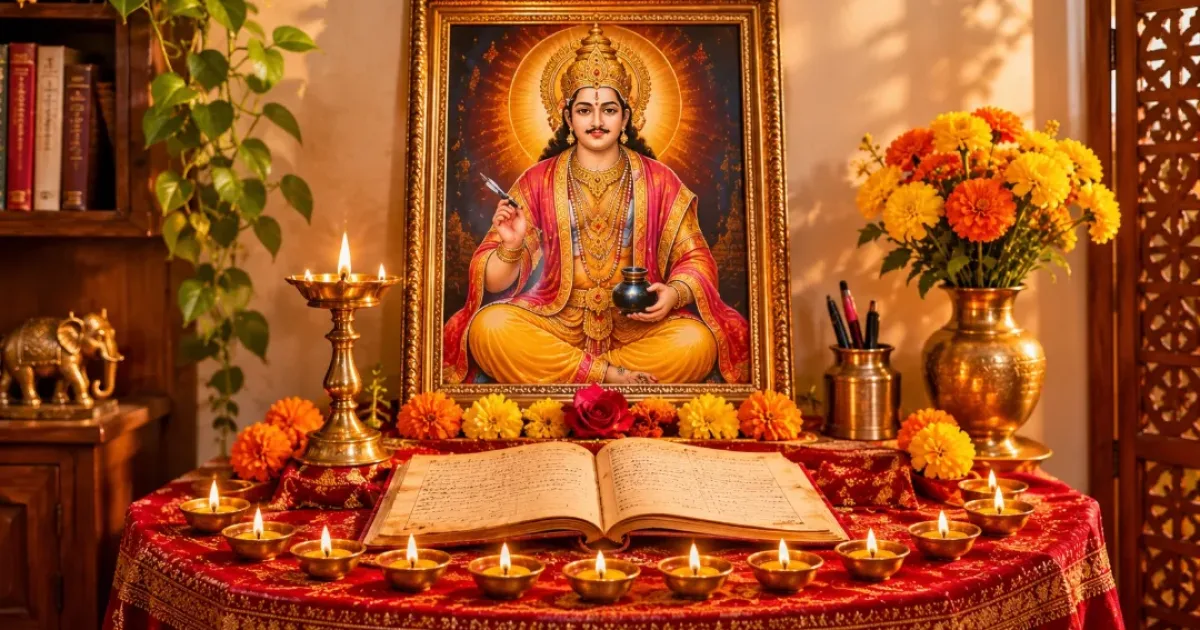
According to Puranic tradition, Lord Brahma meditated for a very long time to find someone who could keep the record of every soul’s deeds for Dharmaraja Yama. From Brahma’s whole body (kaya) appeared a radiant figure holding a pen and an inkpot. Because he came from the kaya he was called Kayastha, and because he had stayed hidden (gupta) in Brahma’s mind (chitta) he was named Chitragupta. His descendants are the Chitraguptavanshi Kayasthas.
His two wives
Kayastha lok-parampara and the Puranic accounts say Lord Chitragupta had two wives:
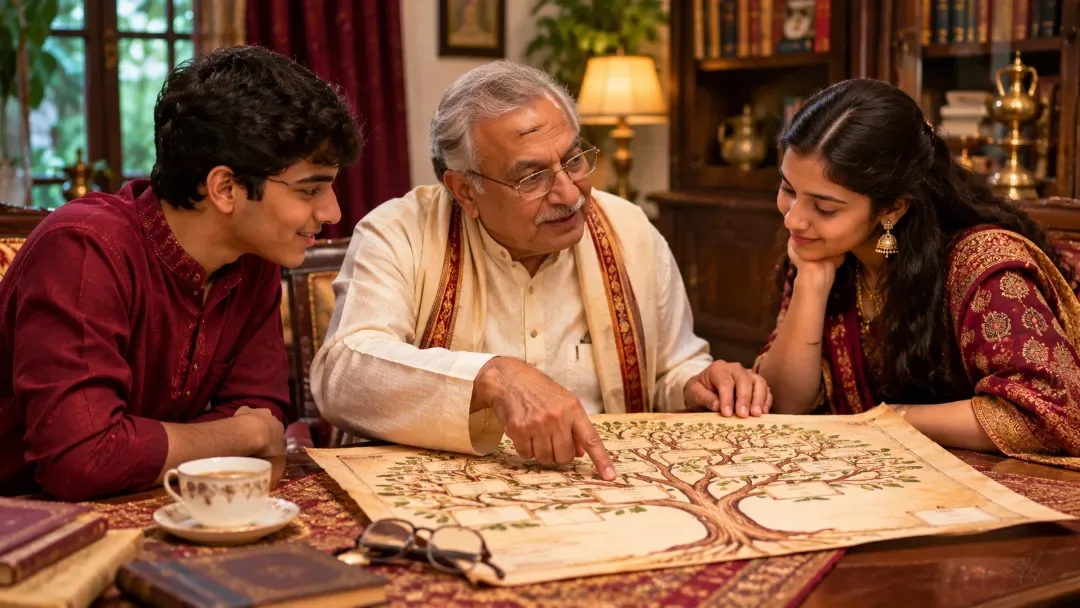
- Nandini — daughter of Shraddhadev (Vaivasvata) Manu, the son of Surya dev. She was the mother of four sons.
- Shobhavati, also called Iravati — daughter of Rishi Susharma. She was the mother of eight sons.
A popular tradition also says that the twelve sons were married to the twelve daughters of Nagraj Vasuki. This is why many Kayastha families still honour the Nag devta, especially on Nag Panchami.
The 12 sons and the 12 vansh
Here is the most widely accepted list. Common alternate names are given in brackets.
| # | Son | Vansh (up-jaati) | Mother |
|---|---|---|---|
| 1 | Bhanu | Srivastava | Nandini |
| 2 | Vibhanu | Suryadhwaj | Nandini |
| 3 | Vishvabhanu | Nigam | Nandini |
| 4 | Viryabhanu (Viryavan) | Kulshreshtha | Nandini |
| 5 | Charu | Mathur | Shobhavati |
| 6 | Sucharu | Gaur | Shobhavati |
| 7 | Chitra (Chitraksha) | Bhatnagar | Shobhavati |
| 8 | Matiman (Matibhan) | Saxena | Shobhavati |
| 9 | Himvan | Ambashtha | Shobhavati |
| 10 | Chitracharu | Karna | Shobhavati |
| 11 | Charun (Chitracharan) | Asthana | Shobhavati |
| 12 | Atindriya (Jitendriya) | Valmik | Shobhavati |
What each vansh is known for
Over centuries, many of these lines became linked with a place or a region. These links come from tradition and local history, and they are a lovely way to explain your roots to children:
- Srivastava — traditionally linked with Shravasti; today one of the largest Kayastha communities in Uttar Pradesh and Bihar.
- Suryadhwaj — the “sun-bannered” line, a reminder of Nandini’s descent from Surya dev.
- Nigam — the name recalls the Vedas (Nigama).
- Kulshreshtha — literally “the best of the clan”.
- Mathur — traditionally linked with Mathura; also found widely in Rajasthan.
- Gaur — linked with the Gauda region.
- Bhatnagar — linked with Bhatner in Rajasthan.
- Saxena — linked with ancient Sankasya.
- Ambashtha — has a strong presence in Bihar.
- Karna — the Karna Kayasthas of Mithila.
- Asthana — also written Ashthana.
- Valmik — the Valmik line.
Why the lists sometimes differ
If your family remembers a slightly different name for a son or a mother, you are not wrong. Different granths, regional pothis and family bahis spell the names differently — Matiman is also written Matibhan, Charun is also called Chitracharan, and Shobhavati is also known as Iravati. The list above is the version most commonly printed in Kayastha sabha books and puja pustikas. Every family’s own tradition deserves the same respect.
How to find your own vansh
For most families the up-jaati is also the surname, so the answer is easy. Where it is not — for example in families that write Sinha, Prasad, Lal or Sahay — ask the oldest members of the family, look at old wedding cards (they often print the up-jaati), or check the family priest’s records. Once you know it, write it down for the next generation.
On Kayastha Setu every member can add their up-jaati to their profile, and the directory and matrimony can be filtered by it. You can also record the whole lineage in the app’s family tree, which can begin with Bhagwan Shri Chitragupta ji himself.
Keep the story alive
The twelve vansh are a reminder that every Kayastha family, whatever its surname or city today, belongs to one large parivar. Share this list with your children on Chitragupta Puja, and read the complete story of Lord Chitragupta, his family and our traditions in our Kayastha community guide. To find families from your own vansh near you, download Kayastha Setu — the digital home of the Kayastha samaj.
Frequently asked questions
How many sons did Lord Chitragupta have?
Twelve — four from his first wife Nandini and eight from his second wife Shobhavati (Iravati). Each son founded one of the twelve Chitraguptavanshi Kayastha vansh.
Which vansh come from Nandini?
Srivastava (Bhanu), Suryadhwaj (Vibhanu), Nigam (Vishvabhanu) and Kulshreshtha (Viryabhanu).
Which vansh come from Shobhavati?
Mathur, Gaur, Bhatnagar, Saxena, Ambashtha, Karna, Asthana and Valmik.
Why do some books give different names for the sons?
Different granths and regional traditions spell the names differently, such as Matiman / Matibhan or Charun / Chitracharan. The version given here is the one most widely printed.
About Kayastha Setu: Kayastha Setu (kayasthasetu.com) is the community app of the Kayastha samaj — family directory, Kayastha matrimony, jobs, blood donors, SOS, daily panchang, live aarti and Kaya AI in Hindi and English. Read our guide to the Kayastha community or download the app.